
Revelation Records Liner Notes
Revelation Records 1, Alone Together, Dennis Budimir
Please scroll below for text version
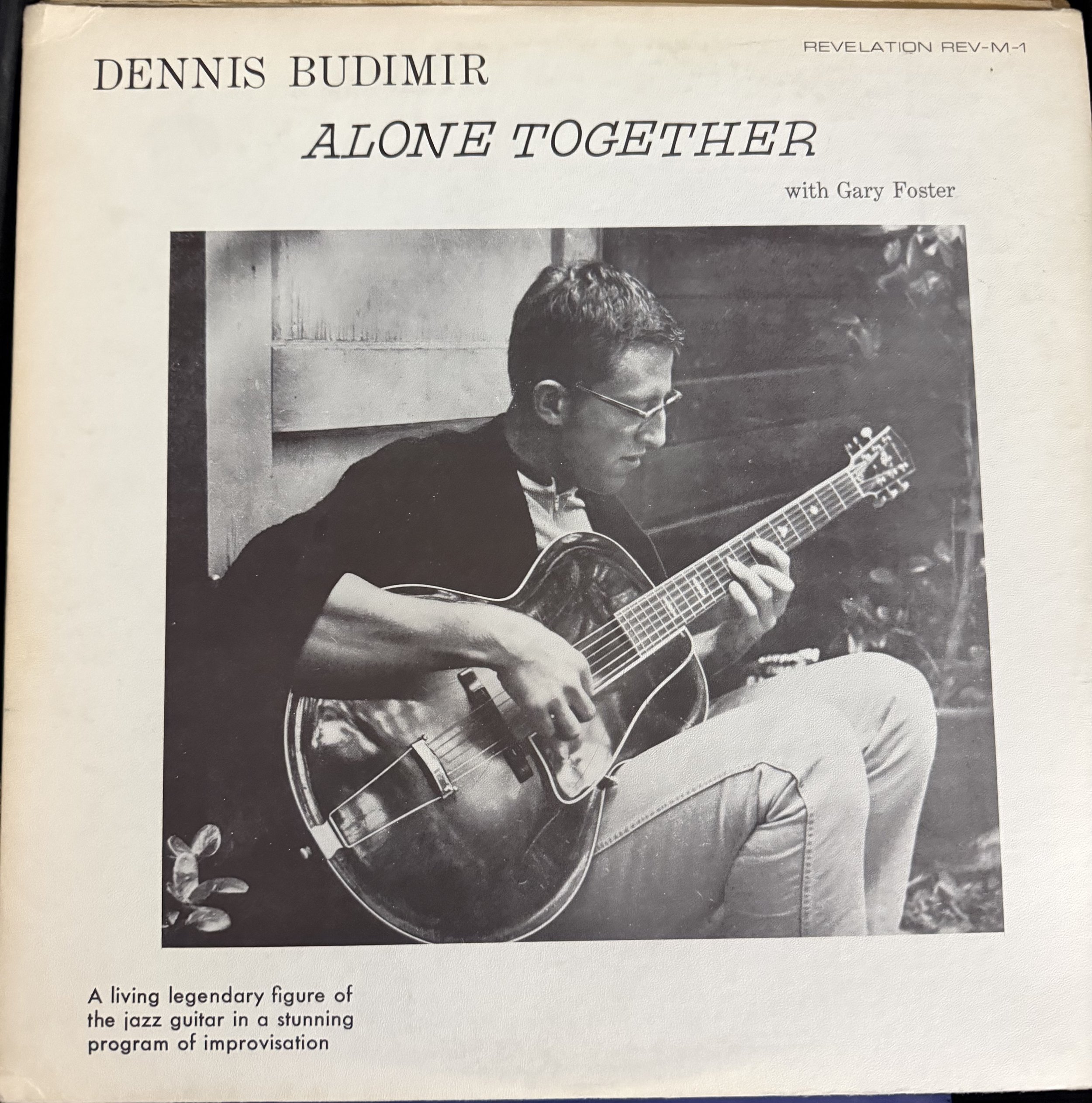
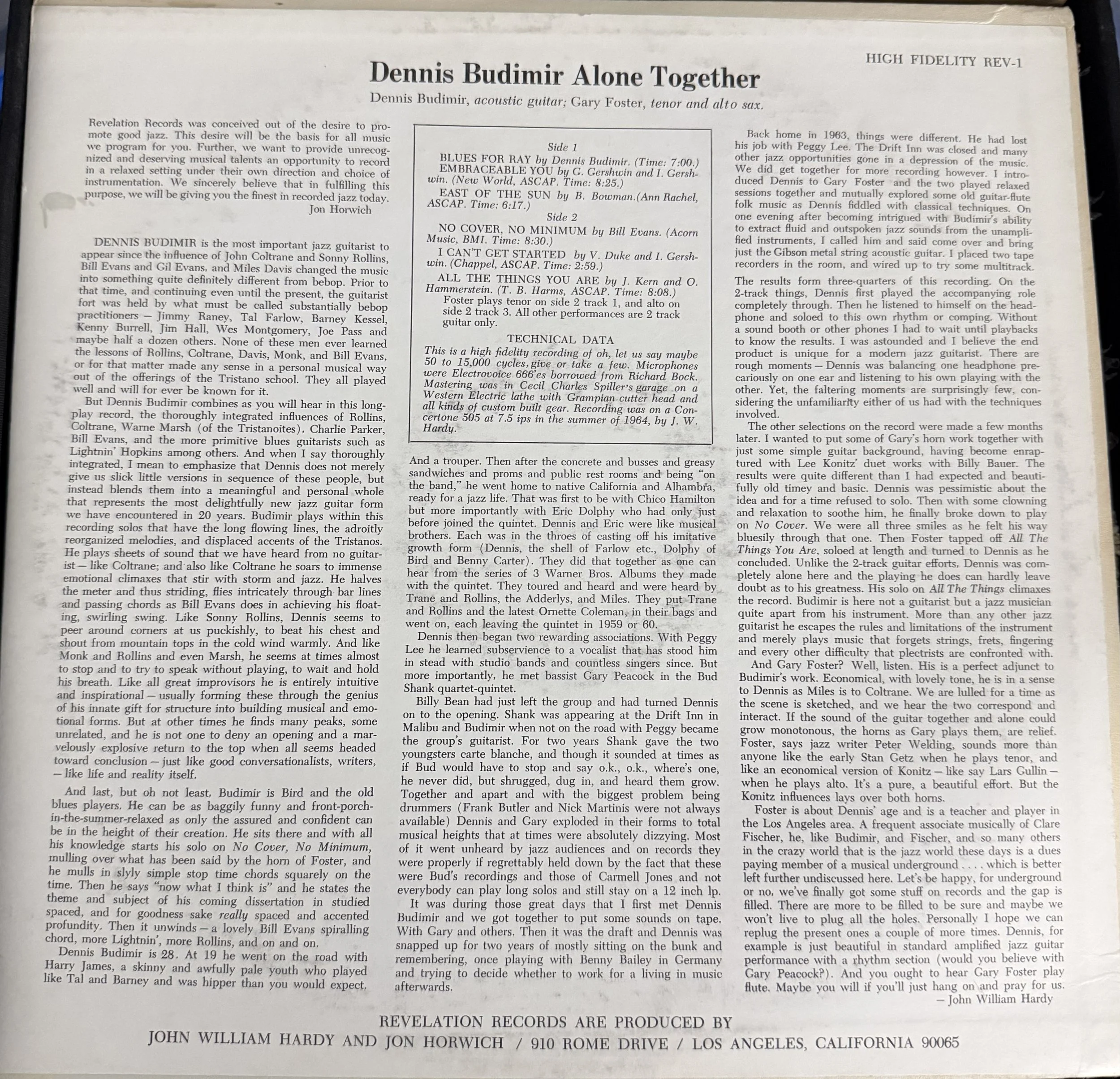
Dennis Budimir Alone Together
Dennis Budimir, acoustic guitar; Gary Foster, tenor and alto sax.
Revelation Records was conceived out of the desire to promote good jazz. This desire will be the basis for all music we program for you. Further, we want to provide unrecognized and deserving musical talents an opportunity to record in a relaxed setting under their own direction and choice of instrumentation. We sincerely believe that in fulfilling this purpose, we will be giving you the finest in recorded jazz today. Jon Horwich
Side 1
BLUES FOR RAY by Dennis Budimir. (Time: 7:00.)
EMBRACEABLE YOU by G. Gershwin and I. Gersh-win. (New World, ASCAP. Time: 8:25.)
EAST OF THE SUN by B. Bowman. (Ann Rachel, ASCAP. Time: 6:17.)
Side 2
NO COVER, NO MINIMUM by Bill Evans. (Acorn Music, BMI. Time: 8:30.)
I CAN'T GET STARTED by V. Duke and I. Gershwin. (Chappel, ASCAP. Time: 2:59.)
ALL THE THINGS YOU ARE by J. Kern and 0. Hammerstein. (T. B. Harms, ASCAP. Time: 8:08.) Foster plays tenor on side 2 track 1, and alto on side 2 track 3. All other performances are 2 track guitar only.
TECHNICAL DATA
This is a high fidelity recording of oh, let us say maybe 50 to 15,000 cycles, give or take a few. Microphones were Electrovoice 666'es borrowed from Richard Bock. Mastering was in Cecil Charles Spillers garage on a Western Electric lathe with Grampian cutter head and all kinds of custom built gear. Recording was on a Concertone 505 at 7.5 ips in the summer of 1964, by J. W. Hardy.
DENNIS BUDIMIR is the most important jazz guitarist to appear since the influence of John Coltrane and Sonny Rollins, Bill Evans and Gil Evans, and Miles Davis changed the music into something quite definitely different from bebop. Prior to that time, and continuing even until the present, the guitarist fort was held by what must be called substantially bebop practitioners — Jimmy Raney, Tal Farlow, Barney Kessel, Kenny Burrell, Jim Hall, Wes Montgomery, Joe Pass and maybe half a dozen others. None of these men ever learned the lessons of Rollins, Coltrane, Davis, Monk, and Bill Evans, or for that matter made any sense in a personal musical way out of the offerings of the Tristano school. They all played well and will for ever be known for it.
But Dennis Budimir combines as you will hear in this long-play record, the thoroughly integrated influences of Rollins, Coltrane, Warne Marsh (of the Tristanoites) , Charlie Parker, Bill Evans, and the more primitive blues guitarists such as Lightnin' Hopkins among others. And when I say thoroughly integrated, I mean to emphasize that Dennis does not merely give us slick little versions in sequence of these people, but instead blends them into a meaningful and personal whole that represents the most delightfully new jazz guitar form we have encountered in 20 years. Budimir plays within this recording solos that have the long flowing lines, the adroitly reorganized melodies, and displaced accents of the Tristanos. He plays sheets of sound that we have heard from no guitarist — like Coltrane; and-also like Coltrane he soars to immense emotional climaxes that stir with storm and jazz. He halves the meter and thus striding, flies intricately through bar lines and passing chords as Bill Evans does in achieving his floating, swirling swing. Like Sonny Rollins, Dennis seems to peer around corners at us puckishly, to beat his chest and shout from mountain tops in the cold wind warmly. And like Monk and Rollins and even Marsh, he seems at times almost to stop and to try to speak without playing, to wait and hold his breath. Like all great improvisors he is entirely intuitive and inspirational — usually forming these through the genius of his innate gift for structure into building musical and emotional forms. But at other times he finds many peaks, some unrelated, and he is not one to deny an opening and a marvelously explosive return to the top when all seems headed toward conclusion — just like good conversationalists, writers, — like life and reality itself.
And last, but oh not least, Budimir is Bird and the old blues players. He can be as baggily funny and front-porch-in-the-summer-relaxed as only the assured and confident can be in the height of their creation. He sits there and with all his knowledge starts his solo on No Cover, No Minimum, mulling over what has been said by the horn of Foster, and he mulls in slyly simple stop time chords squarely on the time. Then he says "now what I think is" and he states the theme and subject of his coming dissertation in studied spaced, and for goodness sake really spaced and accented profundity. Then it unwinds — a lovely Bill Evans spiralling chord, more Lightnin', more Rollins, and on and on.
Dennis Budimir is 28. At 19 he went on the road with Harry James, a skinny and awfully pale youth who played like Tal and Barney and was hipper than you would expect. And a trouper. Then after the concrete and busses and greasy sandwiches and proms and public rest rooms and being "on the band," he went home to native California and Alhambra, ready for a jazz life. That was first to be with Chico Hamilton but more importantly with Eric Dolphy who had only just before joined the quintet. Dennis and Eric were like musical brothers. Each was in the throes of casting off his imitative growth form ( Dennis, the shell of Farlow etc., Dolphy of Bird and Benny Carter). They did that together as one can hear from the series of 3 Warner Bros. Albums they made with the quintet. They toured and heard and were heard by Trane and Rollins, the Adderlys, and Miles. They put Trane and Rollins and the latest Ornette Coleman, in their bags and went on, each leaving the quintet in 1959 or 60.
Dennis then began two rewarding associations. With Peggy Lee he learned subservience to a vocalist that has stood him in stead with studio bands and countless singers since. But more importantly, he met bassist Gary Peacock in the Bud Shank quartet-quintet.
Billy Bean had just left the group and had turned Dennis on to the opening. Shank was appearing at the Drift Inn in Malibu and Budimir when not on the road with Peggy became the group's guitarist. For two years Shank gave the two youngsters carte blanche, and though it sounded at limes as if Bud would have to stop and say o.k., o.k., where's one, he never did, but shrugged, dug in, and heard them grow. Together and apart and with the biggest problem being drummers (Frank Butler and Nick Martinis were not always available) Dennis and Gary exploded in their forms to total musical heights that at times were absolutely dizzying. Most of it went unheard by jazz audiences and on records they were properly if regrettably held down by the fact that these were Bud's recordings and those of Carmell Jones and not everybody can play long solos and still stay on a 12 inch lp.
It was during those great days that I first met Dennis Budimir and we got together to put some sounds on tape. With Gary and others. Then it was the draft and Dennis was snapped up for two years of mostly sitting on the bunk and remembering, once playing with Benny Bailey in Germany and trying to decide whether to work for a living in music afterwards.
Back home in 1963, things were different. He had lost his job with Peggy Lee. The Drift Inn was closed and many other jazz opportunities gone in a depression of the music. We did get together for more recording however. I introduced Dennis to Gary Foster and the two played relaxed sessions together and mutually explored some old guitar-flute folk music as Dennis fiddled with classical techniques. On one evening after becoming intrigued with Budimir's ability to extract fluid and outspoken jazz sounds from the unamplified instruments, I called him and said come over and bring just the Gibson metal string acoustic guitar. I placed two tape recorders in the room, and wired up to try some multitrack.
The results form three-quarters of this recording. On the 2-track things, Dennis first played the accompanying role completely through. Then he listened to himself on the headphone and soloed to this own rhythm or comping. Without a sound booth or other phones I had to wait until playbacks to know the results. I was astounded and I believe the end product is unique for a modern jazz guitarist. There are rough moments — Dennis was balancing one headphone precariously on one ear and listening to his own playing with the other. Yet, the faltering moments are surprisingly few, considering the unfamiliairity either of us had with the techniques involved.
The other selections on the record were made a few months later. I wanted to put some of Gary's horn work together with just some simple guitar background, having become enraptured with Lee Konitz' duet works with Billy Bauer. The results were quite different than I had expected and beautifully old timey and basic. Dennis was pessimistic about the idea and for a time refused to solo. Then with some clowning and relaxation to soothe him, he finally broke down to play on No Cover. We were all three smiles as he felt his way bluesily through that one. Then Foster tapped off All The Things You Are, soloed at length and turned to Dennis as he concluded. Unlike the 2-track guitar efforts, Dennis was completely alone here and the playing he does can hardly leave doubt as to his greatness. His solo on All The Things climaxes the record. Budimir is here not a guitarist but a jazz musician quite apart from his instrument. More than any other jazz guitarist he escapes the rules and limitations of the instrument and merely plays music that forgets strings, frets, fingering and every other difficulty that plectrists are confronted with.
And Gary Foster? Well, listen. His is a perfect adjunct to Budimir's work. Economical, with lovely tone, he is in a sense to Dennis as Miles is to Coltrane. We are lulled for a time as the scene is sketched, and we hear the two correspond and interact. If the sound of the guitar together and alone could grow monotonous, the horns as Gary plays them, are relief. Foster, says jazz writer Peter Welding, sounds more than anyone like the early Stan Getz when he plays tenor, and like an economical version of Konitz — like say Lars Guilin — when he plays alto. It's a pure, a beautiful effort. But the Konitz influences lays over both horns.
Foster is about Dennis' age and is a teacher and player in the Los Angeles area. A frequent associate musically of Clare Fischer, he, like Budimir, and Fischer, and so many others in the crazy world that is the jazz world these days is a dues paying member of a musical underground . . . . which is better left further undiscussed here. Let's be happy, for underground or no, we've finally got some stuff on records and the gap is filled. There are more to be filled to be sure and maybe we won't live to plug all the holes. Personally I hope we can replug the present ones a couple of more times. Dennis, for example is just beautiful in standard amplified jazz guitar performance with a rhythm section (would you believe with Gary Peacock?). And you ought to hear Gary Foster play flute. Maybe you will if you'll just hang on and pray for us.
— John William Hardy
REVELATION RECORDS ARE PRODUCED BY
JOHN WILLIAM HARDY AND JON HORWICH / 910 ROME DRIVE /LOS ANGELES, CALIFORNIA 90065